
Foundations
Part of When to review programmatic advertising foundations for your agency
Programmatic advertising market entry checklist explained for English agencies
A programmatic advertising market entry checklist for English agencies, covering demand evidence, data duties, platform access and the gaps that stall launches.
What to take away
- Programmatic advertising is the automated buying and selling of digital ad space through platforms rather than direct negotiation.
- Demand evidence comes firstthe IAB UK Insight Archive is the trade body's index of digital adspend research you can use to size the market.
- Data protection duties sit with the agency as controller or processor, so document lawful bases before you trade.
- Platform access, measurement and trading talent are the three operational gaps that stall most English launches.
- Budget 13 weeks of parallel running before you take programmatic to a paying client.
Confirm demand before you build
Start with published numbers rather than a hunch. The Insight Archive collects IAB UK adspend and sector research, and it is the fastest way to see which formats and advertiser categories are growing. Use it to decide whether your existing clients already buy programmatically through someone else.
IAB UK also offers membership and the Gold Standard accreditation for agencies that want to demonstrate supply-chain transparency.
Segment that demand by sector. A retail client and a business-to-business client need different supply paths, so one entry plan rarely fits both.
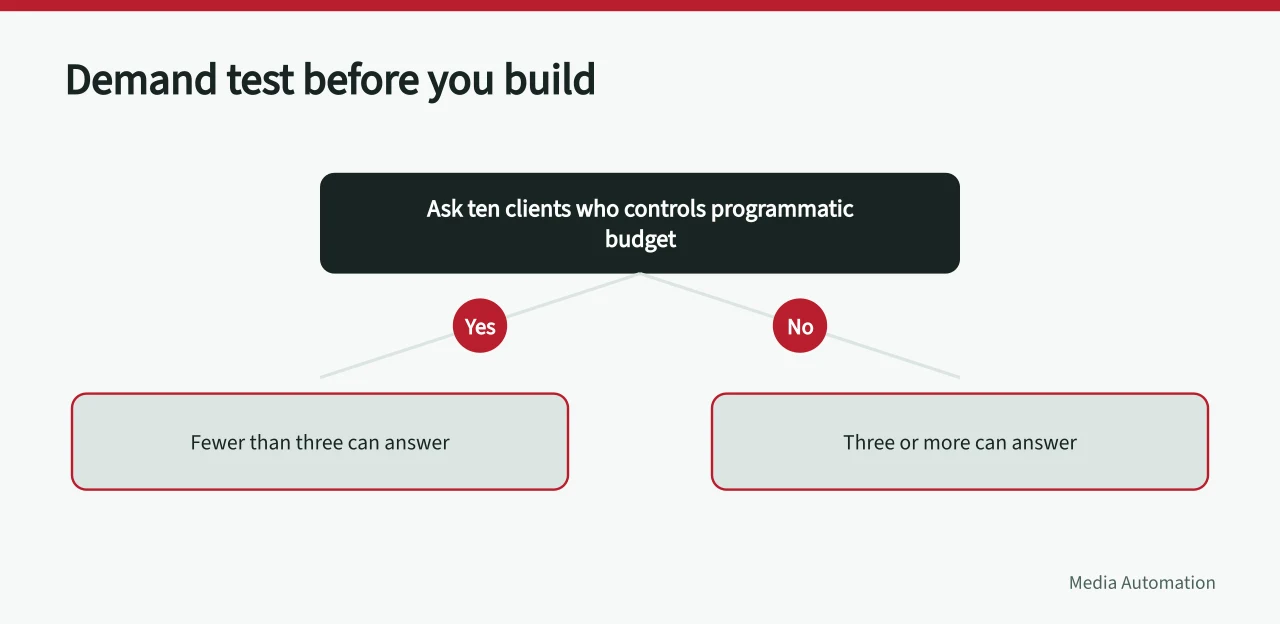
Then test that assumption directly. Ask ten current clients what share of their digital budget is bought through platforms, and who controls it. If fewer than three can answer, your entry plan is speculative.
Map your data duties
Any agency trading programmatically handles personal data, whether for targeting, frequency capping or reporting. Identify your role under UK GDPR: controller, processor or joint controller. Record the lawful basis for each processing activity.
Data duties before launch
- Identify UK GDPR rolecontroller, processor or joint controller
- Record lawful basis for each processing activity
- Keep consent records separate from campaign data
- Contract every vendor with purpose and retention limit
- Write data mapcollection, storage, retention, deletion
Audience segmentation should rest on published statistics rather than guesswork. The Office for National Statistics publishes home internet and social media usage data that helps you describe an addressable audience credibly to a client. Keep consent records separate from campaign data so an audit trail survives a platform change.
The Information Commissioner's Office (ICO) is the UK regulator. Under the Data Protection (Charges and Information) Regulations 2018, most agencies that process personal data must register with the ICO and pay an annual data protection fee, unless exempt. The Privacy and Electronic Communications Regulations 2003 (PECR) also apply to cookies and similar tracking used in programmatic targeting. Although this checklist is for English agencies, these duties are UK-wide.
Check every vendor in the chain. Demand-side platforms, data providers and verification tools each need a contract naming the processing purpose and the retention limit. For consent management, platforms such as OneTrust and Cookiebot record consent signals; data providers such as LiveRamp and Experian supply audience segments. If a vendor will not sign, remove it from the plan rather than carry the risk.
Write a short data map covering collection point, storage, retention period and deletion route. If you cannot complete it, pause the launch.
Check platform and commercial readiness
Commercial modelling matters as much as media. Agency trading desks, managed service fees and platform take rates all compress margin differently. The programmatic advertising commercial opportunities piece compares those routes for smaller English agencies.
Typical market pricing is a platform fee plus a share of media spend. Reseller and managed service fees are commonly quoted at 15 to 30 per cent of media spend. Ask for the platform fee and minimum commitment in writing.
Use this numbered checklist as a go or no-go check before you commit spend.
| Step | Checklist item | Minimum evidence | Owner |
|---|---|---|---|
| 1 | Confirm client demand | Three named clients with budget | Commercial lead |
| 2 | Complete data compliance | Completed data map and lawful bases | Data protection lead |
| 3 | Secure platform access | Live seat or reseller agreement | Trading lead |
| 4 | Set measurement | Agreed KPIS and reporting cadence | Analytics lead |
| 5 | Cover trading talent | One trained trader, one backup | Operations lead |
Named platforms and access routes
For the platform access step, the main demand-side platforms you can buy on directly are Google's Display & Video 360 (DV360), The Trade Desk, Amazon DSP, Microsoft Advertising (which now includes Xandr) and Yahoo DSP. Each sets its own minimum spend and fee structure.
If you are not ready for a direct seat, approach an agency trading desk or managed service. In the UK, the large holding-company trading desks include GroupM (WPP), Publicis Media Exchange (PMX), Omnicom Media Group, Dentsu and Havas. They can provide access, trading and sometimes managed service for a fee.
For verification and brand safety, the common vendors are Integral Ad Science (IAS), DoubleVerify and Google Ad Manager's verification tools. Add one of these to your plan before the pilot starts.
Build the trading operation
Trading discipline is what separates a pilot that scales from one that stalls. Set a weekly QA routine before the pilot starts: check pacing, delivery against budget, placement exclusions and any creative that failed review. Log each check so the client sees a process rather than a promise.
Campaign settings to standardise first
Standardise the settings you will reuse on every account: naming conventions, viewability thresholds, brand safety lists and frequency caps. LinkedIn's Ad Tips & Best Practices gives operational guidance on campaign structure and optimisation that transfers to most platforms. Document each default so a new trader can follow it without asking.
Proving the model works
Run one pilot account for 13 weeks with a fixed budget. For an illustrative comparison, assume the client's direct-buy baseline was 60 conversions at £200 cost per acquisition, a £12,000 spend. The programmatic pilot spends the same £12,000 and records 80 conversions, giving a £150 cost per acquisition. That is a £50 reduction per acquisition on the same budget.
Keep pilot reporting simple: spend, impressions, viewability, cost per acquisition and one brand metric the client already tracks. Anything more invites argument about numbers nobody agreed in advance.
Common questions
Here are the questions English agencies ask most often before committing to programmatic.
How long does it take to launch programmatically?
Allow 4 weeks for data mapping and lawful bases, 4 weeks for platform access and integration, 2 weeks for trader training, then a 13 week live pilot. That is 23 weeks from kick-off to pilot report.
Do we need our own platform seat?
Not immediately. Many English agencies start on a reseller or managed service agreement and move to a direct seat once monthly spend justifies the fee.
What is the biggest compliance risk?
Trading personal data without a documented lawful basis. That risk sits with the agency, not the platform.
Can we enter without hiring a trader?
Yes, through a managed service, but margin suffers. Plan to train an existing media buyer within 26 weeks.