
Tools and providers
Part of Retail media networks: a UK programmatic buying guide
Retail media networks: a UK programmatic buying guide
A commercial guide to UK retail media networks and programmatic buying, covering Tesco, Sainsbury's and Boots, consent rules, buying routes and measurement.
What to take away
- Retail media networks let brands buy advertising on a retailer's own sites, apps and off-site inventory using loyalty and sales data.
- In the UK, Tesco, Sainsbury's and Boots run three of the best-known networks, each with different data, formats and buying routes.
- Programmatic access is usually private, not open exchange, so expect private marketplace deals, direct buys or retailer-operated platforms.
- Consent, ad labelling and transparency obligations sit with the advertiser as well as the network.
- Measure sales lift and incrementality rather than relying on last-click return on ad spend alone.
Why retail media is different from open-web programmatic
Retail media puts advertising inside a retailer's own environment. The signal comes from loyalty schemes, till data and app behaviour rather than third-party cookies. That changes targeting, measurement and negotiation.
The closed nature is the point. You know a shopper bought cat food, not just that they read about pets. Scale is limited to the retailer's audience, so reach planning often needs several networks.
Most networks separate on-site and off-site inventory. On-site placements catch shoppers close to purchase, while off-site media extends reach using the retailer's audience data. The mix changes the role of open-web display and connected TV in your plan.
Buying routes vary. Some networks sell through their own platform, some use a demand-side platform, and many run private marketplace deals. For deal mechanics, see How to evaluate private marketplace programmatic deals in the UK.
How the main UK networks compare
Main data asset
- Tesco Media and Insight Platform
- Clubcard and dunnhumby
- Sainsbury's Nectar360
- Nectar
- Boots Media Group
- Advantage Card
Common formats
- Tesco Media and Insight Platform
- On-site sponsored products, display and off-site media
- Sainsbury's Nectar360
- On-site ads, off-site display and digital screens
- Boots Media Group
- boots.com placements, app inventory and off-site display
Typical buying route
- Tesco Media and Insight Platform
- Managed service, platform access and private deals
- Sainsbury's Nectar360
- Nectar360 team and programmatic deals
- Boots Media Group
- Managed service and programmatic partners
Each network combines a data asset with ad inventory. Tesco Media and Insight Platform draws on Clubcard and dunnhumby. Sainsbury's Nectar360 uses Nectar. Boots Media Group uses Advantage Card. Sponsorship, display and off-site extensions differ, so check current formats and minimums before you brief a media plan.
UK retail media networks
Tesco Media
- Data asset
- Clubcard, dunnhumby
- Formats
- Sponsored products, display
- Buying route
- Managed, platform, deals
Nectar360
- Data asset
- Nectar
- Formats
- On-site, off-site, screens
- Buying route
- Team, programmatic deals
Boots Media
- Data asset
- Advantage Card
- Formats
- boots.com, app, off-site
- Buying route
- Managed, programmatic partners
Consent and data rules you must plan for
Retail media relies on logged-in shoppers and loyalty data. UK GDPR still applies. You need a lawful basis, clear notice and valid consent where required. The ICO's UK GDPR guidance sets out the tests.
Electronic marketing adds PECR rules for email, SMS and some app messages. The Privacy and Electronic Communications Regulations sit alongside UK GDPR and affect how you contact shoppers.
Ads must also be identifiable. The CAP Code requires marketing communications to be obviously recognisable as such. The advertising codes explain the rules for on-site placements and sponsored products.
A step-by-step buying process
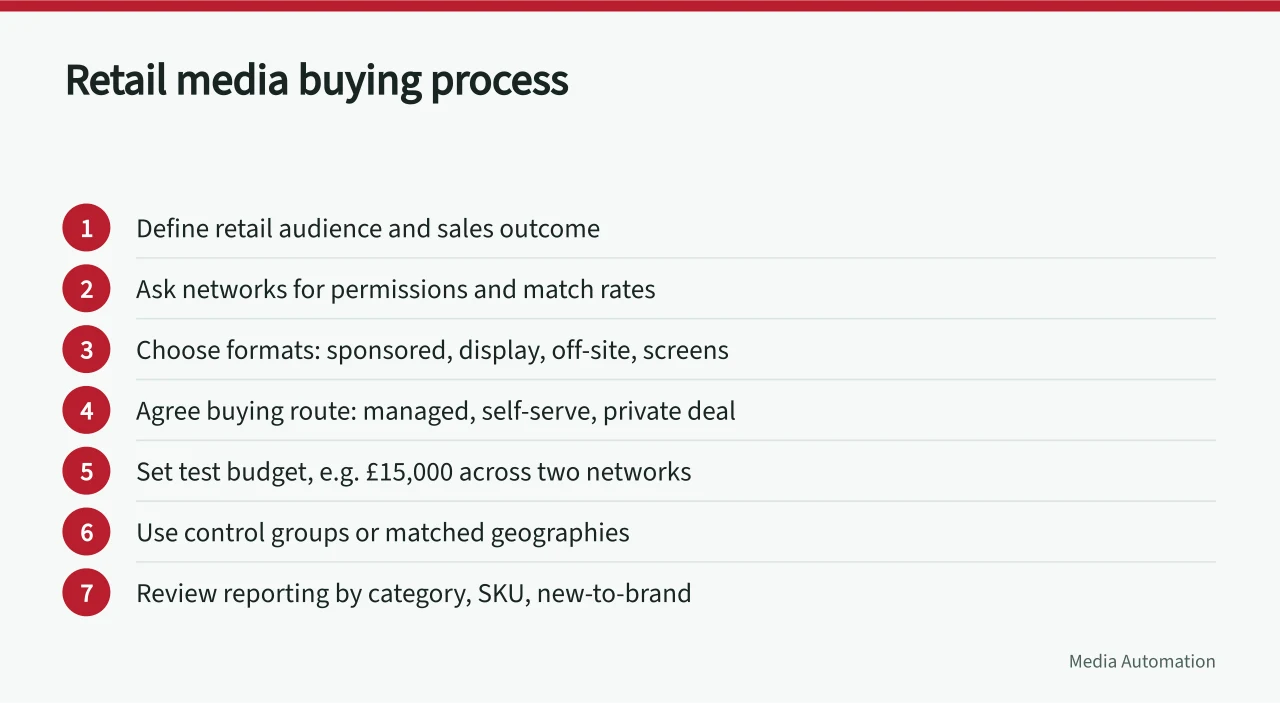
- Define the retail audience and the sales outcome you need, such as new buyers or a larger basket.
- Ask each network for its data permissions, match rates and available targeting.
- Choose formatssponsored products, on-site display, off-site programmatic or in-store screens.
- Agree the buying routemanaged service, self-serve platform or private marketplace deal.
- Set a test budget, for example an illustrative £15,000 across two networks for four weeks.
- Use control groups or matched geographies to measure incremental sales.
- Review reporting by category, SKU and new-to-brand rate before scaling.
Before you commit, agree who owns the data, how long it is retained and what happens after the campaign. Those terms matter more in retail media than in open exchange buying.
How to measure retail media properly
Retail media reporting often defaults to return on ad spend, which flatters branded search. Ask for incrementality, new-to-brand buyers, category share and profit after media.
Attribution needs a control. A holdout group or matched geographies is more credible than a platform dashboard alone.
Ask for a reporting split between new and existing customers. Existing-customer sales can look efficient but may have happened anyway. New-to-brand sales are usually the harder test.
For ecommerce teams, the same discipline applies across paid channels. See Programmatic advertising for ecommerce brands in the UK for a wider measurement frame.
Common questions
Do UK retail media networks sell programmatically?
Yes, but mostly through private marketplaces, direct deals or retailer-operated platforms rather than the open exchange. Ask each network which demand-side platforms and deal IDs it supports.
Which UK retail media network should I test first?
Start with the network whose shoppers match your category and whose data you can use lawfully. Tesco, Sainsbury's and Boots are common first tests. A smaller network can suit niche categories better.
How does consent affect retail media targeting?
Consent and notice must cover the data used for advertising. The ICO guidance linked above is the starting point for UK GDPR compliance.
What budget do I need?
There is no universal minimum. As an illustration only, a four-week test might run from £10,000 to £50,000 per network, before fees. Minimum spends and format costs vary by retailer.