Tools and providers
Part of Which programmatic brand safety tools suit UK advertisers?
Which programmatic brand safety tools suit UK advertisers?
Compare UK programmatic brand safety tools, from IAS and DoubleVerify to Pixalate and NewsGuard, with GDPR, fraud and practical UK vendor questions.
What to take away
- Named tools include Integral Ad Science, DoubleVerify, Comscore and Human Security.
- Pixalate and Adloox cover CTV fraud and European verification.
- Zefr and NewsGuard cover social video and news misinformation.
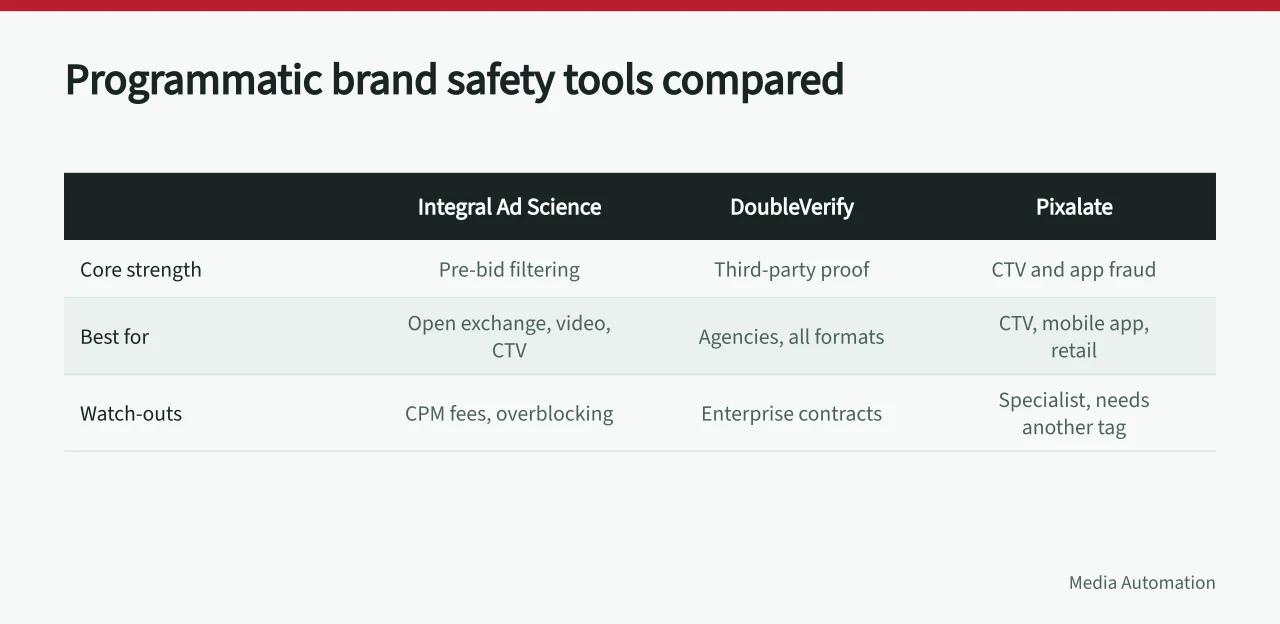
- IAS and DoubleVerify lead third-party verification for display, video and connected TV.
- Most UK advertisers start with an IAS or DoubleVerify tag plus platform pre-bid controls.
- Fraud specialists Human Security and Pixalate focus on invalid traffic and app or CTV risks.
- Match tool to inventory, run a pilot, and check UK GDPR terms before signing.
Why UK brand safety needs a local lens
Brand safety is the practice of keeping ads away from content that could damage a brand. The Wikipedia entry on brand safety sets out the general principle. UK campaigns also face a specific rulebook.
The IAB UK's Gold Standard sets expectations for brand safety, anti-fraud and user experience. UK GDPR and the Data Protection Act 2018 govern personal data used in targeting and verification. The ICO's guide to the UK GDPR explains lawful bases, consent and individual rights.
The ASA and CAP advertising codes require ads to be legal, decent, honest and truthful. Placement controls should support those standards, especially for gambling, alcohol and finance.
The Online Safety Act 2023 places duties on some online services. Those duties can change which user-generated environments suit advertising. Check how your vendor classifies them.
How the main tools compare
What it does
- Integral Ad Science
- Pre-bid filtering, viewability, invalid traffic and contextual targeting.
- DoubleVerify
- Brand safety, viewability, fraud, attention and CTV measurement.
- Comscore
- Contextual categories, invalid traffic and publisher-side measurement.
- Human Security
- Bot detection and sophisticated invalid traffic.
- Pixalate
- CTV and app invalid traffic, plus app-ads.txt checks.
- Adloox
- Independent ad verification, brand safety and fraud in Europe.
- Zefr
- Brand suitability and contextual targeting on YouTube and Meta.
- NewsGuard
- News and misinformation ratings, plus AI content checks.
Best for
- Integral Ad Science
- Large UK advertisers buying open exchange, video and CTV.
- DoubleVerify
- Agencies needing third-party proof across formats.
- Comscore
- Media owners and agencies checking UK inventory.
- Human Security
- High-spend display and video campaigns.
- Pixalate
- Connected TV, mobile app and retail media buys.
- Adloox
- UK advertisers wanting a European alternative.
- Zefr
- Social video campaigns in walled gardens.
- NewsGuard
- Advertisers avoiding false news or AI-generated sites.
Watch-outs
- Integral Ad Science
- CPM fees and tag load; overblocking needs review.
- DoubleVerify
- Enterprise contracts; some features cost extra.
- Comscore
- Less known for pre-bid blocking.
- Human Security
- Fraud focus, not full content safety.
- Pixalate
- Specialist; may need another verification tag.
- Adloox
- Smaller global coverage than IAS or DoubleVerify.
- Zefr
- Limited to platforms it supports.
- NewsGuard
- Ratings cover news, not all programmatic inventory.
UK accreditation
- Integral Ad Science
- MRC viewability and IVT; IAB UK Gold Standard.
- DoubleVerify
- MRC viewability, IVT and CTV; IAB UK Gold Standard.
- Comscore
- MRC viewability and IVT; IAB UK Gold Standard listing to verify.
- Human Security
- Check MRC and IAB UK Gold Standard listings.
- Pixalate
- MRC CTV invalid traffic; check IAB UK Gold Standard listing.
- Adloox
- MRC invalid traffic; check IAB UK Gold Standard listing.
- Zefr
- Check MRC and IAB UK Gold Standard listings.
- NewsGuard
- Not MRC accredited; check IAB UK Gold Standard listing.
IAB UK Gold Standard status changes by product and entity, so verify each vendor's current listing. Comscore and Adloox suit buyers wanting European or publisher-side options. Human Security and Pixalate address fraud and CTV risks. Zefr and NewsGuard help with walled gardens and news. Check public accreditation status and pilot pricing before you commit.
For a UK broadcaster such as ITV buying CTV inventory, CTV invalid traffic checks matter. txt and contextual controls matter.
A five-step selection process
- Define your risk taxonomy. List the content types and fraud signals that matter to your brand, legal team and planners.
- Map data flows. Record what personal data each tool processes, where it is stored and what lawful basis you rely on.
- Run a pilot on live inventory. Use a small budget to compare block rates, invalid traffic reports and viewability before you commit. If you buy private deals, use the same pilot to evaluate private marketplace programmatic deals and check contractual controls.
- Set thresholds and escalation. Agree who reviews blocked domains, how quickly false positives are released and what triggers a vendor review.
- Review quarterly. Check whether the tool still matches your media mix, especially after adding connected TV, retail media or audio.
What to ask vendors about UK compliance
Ask where the vendor processes data and whether it transfers UK personal data outside the UK. Under UK GDPR, transfers need safeguards. Ask for a data processing agreement and a record of sub-processors.
UK compliance questions for vendors
- Where is UK personal data processed?
- Are transfers outside the UK safeguarded?
- Is there a data processing agreement?
- How are consent signals respected?
- Are GIVT and SIVT reported separately?
- How are spoofed domains blocked?
- How are false positives reviewed?
Ask how the vendor handles consent signals. If it reads consent strings or uses personal data for measurement, it must respect the user's choices. The ICO's guidance on how GDPR consent works for programmatic advertising is a useful starting point for media and legal teams.
Ask about fraud reporting. A good vendor separates general invalid traffic from sophisticated invalid traffic. It should explain how it blocks spoofed domains. Ask for sample reports before you buy.
Ask about overblocking. If a tool blocks too much, you lose reach and pay more for clean inventory. Set a review process for false positives and measure blocked impressions against conversions.
Common questions
Do UK advertisers need a separate brand safety tool?
Not always. A demand-side platform with strong pre-bid controls and an independent verification tag may cover most needs. Separate tools make sense when you buy across many exchanges, formats or regions.
How does GDPR affect brand safety verification?
Verification often involves collecting device or page data. That can be personal data under UK GDPR. You need a lawful basis, clear consent where required, and a contract that limits the vendor's use of that data.
Can brand safety tools stop ad fraud?
They can reduce common fraud such as bot traffic and domain spoofing. Pair detection with supply-path controls, ads.txt and regular reporting.
What does brand safety verification cost?
Vendors charge a CPM fee, a platform fee or both. Typical UK verification CPMs run from a few pence to tens of pence per thousand impressions. Platform or licence fees can run from hundreds to several thousand pounds per month. Ask for a pilot price and check whether fees apply to blocked impressions too.